
#2 Barely watched
Pavane: a review of Lee Jong-Pil’s 2026 Netflix film

“Love is an illusion. An illusion that you would love each other forever.”
There is a dance called the pavane. A dance older than cinema itself. When Maurice Ravel composed his Pavane for a Dead Princess in 1899, he borrowed the form to mourn something beautiful and lost. When Park Min-gyu borrowed that title for his novel, he used it to mourn a different kind of loss: the loss of people who walk through the world as if they are already invisible, already buried, already gone. And now, director Lee Jong-pil has borrowed it again for a film that is, in every sense of the word, a pavane. Slow. Deliberate. Heartbreaking in its elegance. And utterly, quietly devastating.
Pavane arrived on Netflix on February 20, 2026, and it has been rattling around in my chest ever since. I watched it alone on a random afternoon thinking it would be a pleasant enough way to spend two hours. But it wasn’t pleasant.It was the kind of film that leaves a strange pressure behind your sternum and makes you stare at the ceiling afterward, trying to figure out what exactly just happened to you.
So let me try to work through it here. Because this film deserves more than a star rating and a hot take. It deserves to be sat with. Which is, of course, exactly what it asks of you.
The Story, Briefly
Pavane is set in 1980s Seoul, the era when South Korea’s obsession with beauty standards began to calcify into something systematic and cruel. Into this world, the
film drops three people who work at the same department store and are, each in their own way, deeply alone.
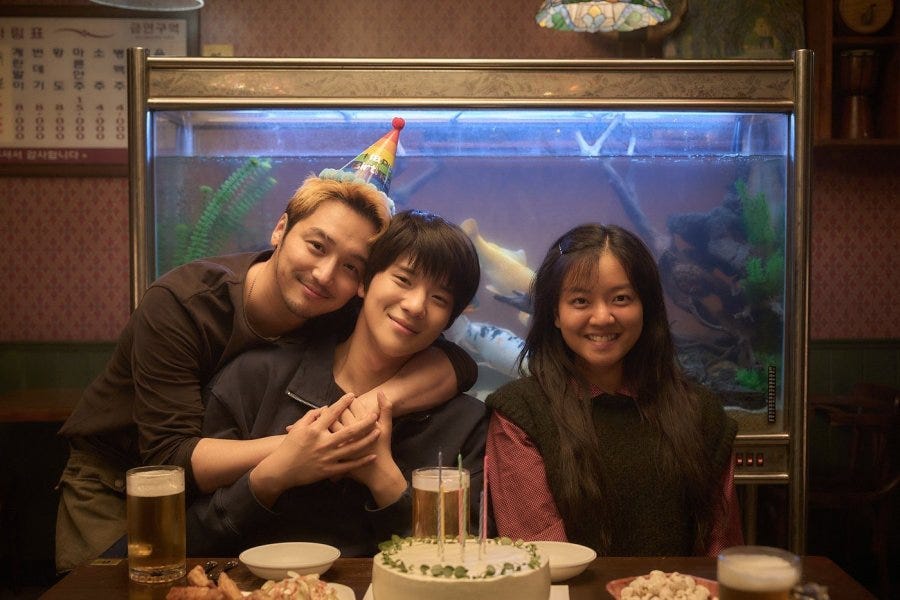
Mi-jung (Go Ah-sung) is a saleswoman who has made an art of disappearing. She avoids eye contact. She speaks in the smallest voice possible. She has internalized, over years of being looked at the wrong way, that the safest thing is to not be looked at all. She is not ugly, the film is careful about this but she has been told by the world around her, in a thousand small and large ways, that she is, and she has believed it.

Kyung-rok (Moon Sang-min) is handsome and knows it or rather, he is used to people telling him so and yet he has given up on the dreams that once animated him and is now drifting, aimless, working a part-time job at the department store as a kind of placeholder life. He sees Mi-jung and is drawn to her, not out of pity, but out of something more instinctive and sincere: he recognizes in her a kind of realness he has been missing.
And then there is Yo-han (Byun Yo-han), who works in the parking lot and loves rock music and old romantic films and chaos, and he is someone who becomes the strange catalyst between the other two — part matchmaker, part philosopher, part force of nature. He’s the film’s most surprising invention: a character who should be comic relief and is instead the film’s beating heart.
That is the story, roughly. Three lonely people, finding each other. It sounds simple, in fact it’s quite the opposite.
The Cinematography: A Language of Its Own
I want to spend a good amount of time here because cinematographer Kim Sung-an has done something genuinely extraordinary with this film, and I don’t think it’s gotten enough attention in the conversation around pavane.

The visual language of this film is cold. That is the first and most deliberate thing. The palette leans into blues and greys and muted greens, particularly in the early sequences set inside and around the department store. These are not beautiful colors in the conventional sense — they are the colors of fluorescent light and concrete and the particular loneliness of commercial spaces. Kim Sung-an shoots the department store’s lower floors and back corridors in a way that makes them feel underground even when they aren’t — close ceilings, narrow frames, the sense of being slightly buried. It is not accidental. Mi-jungworks in these spaces. She lives in them emotionally. The architecture of the frame mirrors her interiority.
What makes this remarkable is how gradually the palette shifts. As Mi-jung begins to slowly let herself be known, the color temperature warms almost imperceptibly.
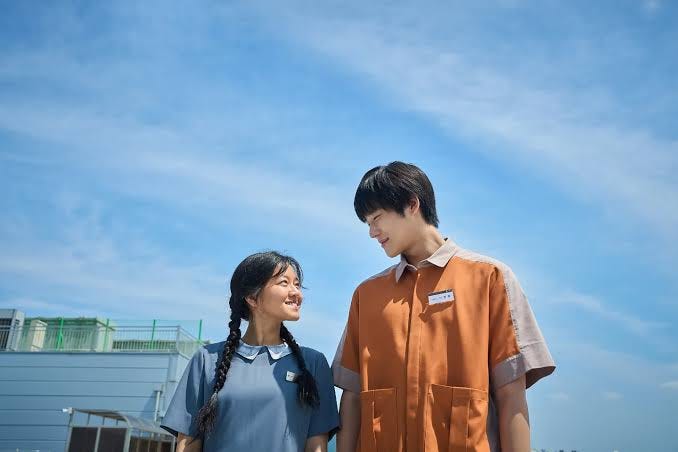
The framing of bodies in this film is also worth noting. Early on, Mi-jung is almost always shot in ways that reduce her — she is at the edge of the frame, partially obscured, given less visual real estate than the space around her. It echoes how she moves through the world: trying to take up as little room as possible. As the film progresses, almost without you noticing, the framing shifts. She begins to occupy the center. She begins to fill the shot. By the end, there are close-ups of her face in the way Kyung-rok looks at her that feel like small acts of cinematic justice.
The Performances
Go Ah-sung has been a known and respected presence in Korean cinema for years, her breakout being Bong Joon-ho’s The Host when she was a teenager but Pavane asks something different of her than she has done before. The role of Mi-jung requires her to communicate an entire inner life through suppression. She cannot be demonstrative. She cannot emote in the conventional sense. And yet you must feel every single thing Mi-jung is feeling, because the whole film depends on it. The performance is built almost entirely from what she withholds — the way her eyes almost meet someone else’s and then slide away, the micro-expression of someone bracing for a rejection that hasn’t come yet, the particular stillness of a person who has learned to be very still.
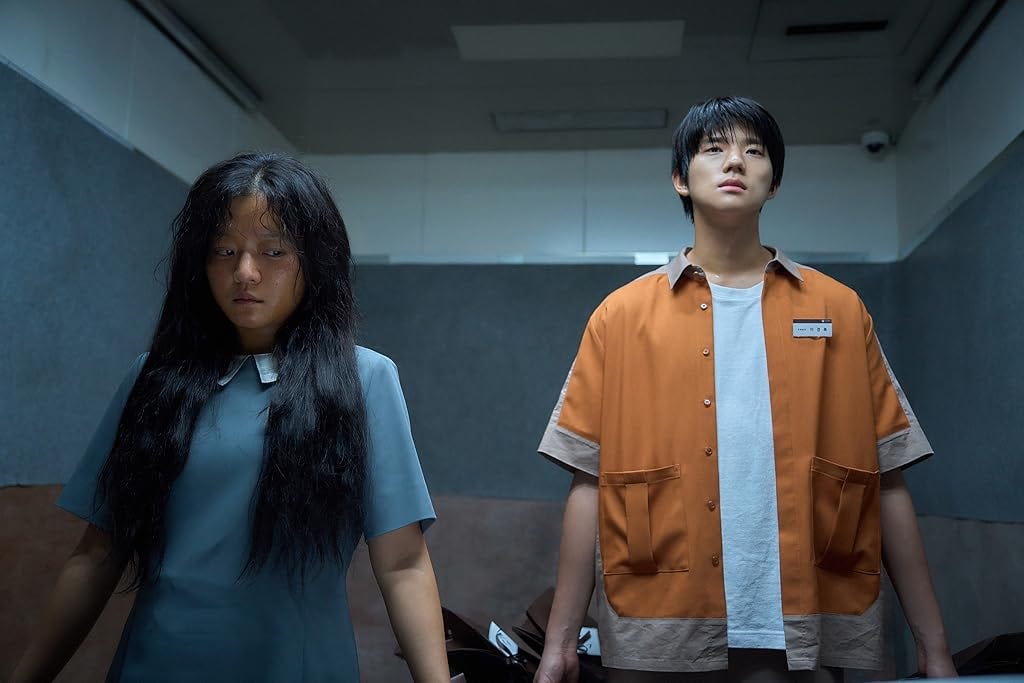
When Mi-jung finally, in the film’s second half, allows herself something like openness, the contrast is so precisely calibrated that it lands with genuine emotional force. You have been watching her hold her breath for an hour. Watching her exhale is one of the most moving things I have seen on screen this year.
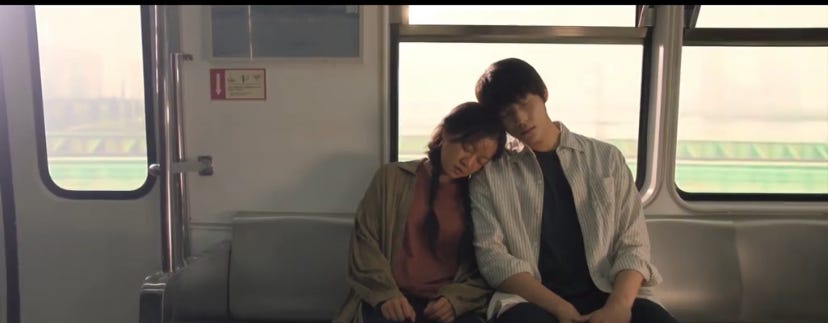
Moon Sang-min as Kyung-rok is playing a much simpler work and he is just as good. It would be easy to play this character as simply the handsome romantic lead, the obvious vehicle for wish fulfillment. Moon resists this. His Kyung-rok is uncertain, sometimes selfish, always genuinely searching. His attraction to Mi-jung is not presented as nobly charitable, it is presented as something that puzzles him too, that he does not fully understand, which
makes it feel real. The chemistry between him and Go Ah-sung is built not on heat but on attentiveness. In the way they watch each other, cautiously, from a distance, and then less cautiously, and then not from a distance at all.
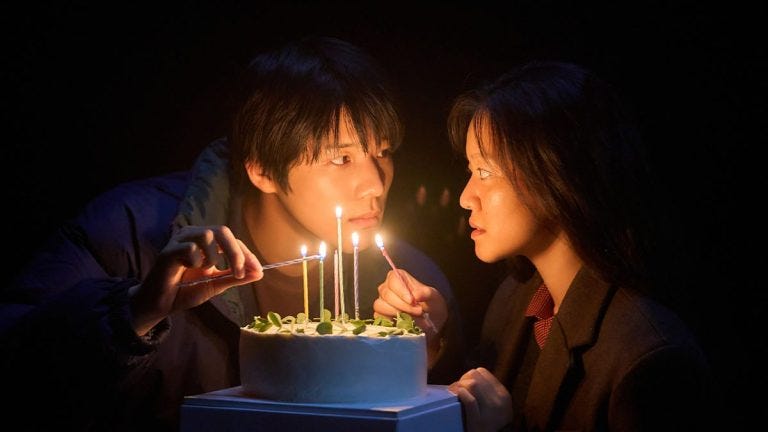
And then there is Byun Yo-han as Yo-han, who gives the film’s most surprising and in some ways most affecting performance. Yo-han is a character who exists at the film’s tonal edges— funny, eccentric, unexpectedly philosophical — and it falls to Byun to make him feel like more than a device. He does it through sheer generosity. His character’s love for both Mi-jung and Kyung-rok is unconditional in a way that quietly reveals how little unconditional love either of them has experienced. He is the film’s most functional human being, and his presence has the effect of making the other characters’ dysfunctions visible without ever making them feel judged for those dysfunctions.
The Themes: On Lookism, Loneliness, and Being Chosen
Pavane engages seriously with lookism, discrimination and social stratification based on physical appearance. It is not a subtle critique: the film is set deliberately in the 1980s, the decade when South Korea’s beauty industry began itsexponential growth alongside the country’s broader economic transformation. The world the film creates is one in which how you look is not just aesthetically significant but socially determinative. People like Mi-jung are not just unloved; they are categorically excluded, made to feel that the social contract does not fully extend to them.But the film does something more nuanced than straight social critique. It is also deeply interested in interiority — in how people internalize the judgments of the world around them.Mi-jung’s problem by the time the film begins is not just that others have treated her badly. It is that she has taken their judgment as objective fact. She has become her ownoppressor. Her invisibility is no longer imposed from outside; it is self-administered. This is a much more complex and painful thing to watch than simple victimhood, and Go Ah-sung plays it with complete honesty.The film’s central question is not whether Mi-jung deserves to be loved but whether she can allow herself to believe she deserves it. And this is where Pavane quietly transcends its own genre. It is not, ultimately, a film about whether the right
person will come along. It is a film about whether you can receive what the right person is offering.
This theme ripples through all three characters. Kyung-rok has given up on his dreams before anyone told him to. Yo-han’s cheerfulness masks his own particular kind of loneliness. These are people who have pre-emptively shrunk their lives to avoid the pain of loss. The film asks what it looks like to un-shrink. To take up space again. To risk.
The title carries all of this weight beautifully. A pavane for a dead princess — mourning someone royal, someone deserving, someone who was never supposed to be dead. Mi-jung is the dead princess of the title. Not literally dead, but socially: erased, dismissed, treated as non-existent. The film is her pavane. And slowly, tenderly, it begins to resurrect her.
The Ending (With Spoilers)
I need to talk about the ending, because it has divided people, and I understand why, and I think both sides are right in their own way.
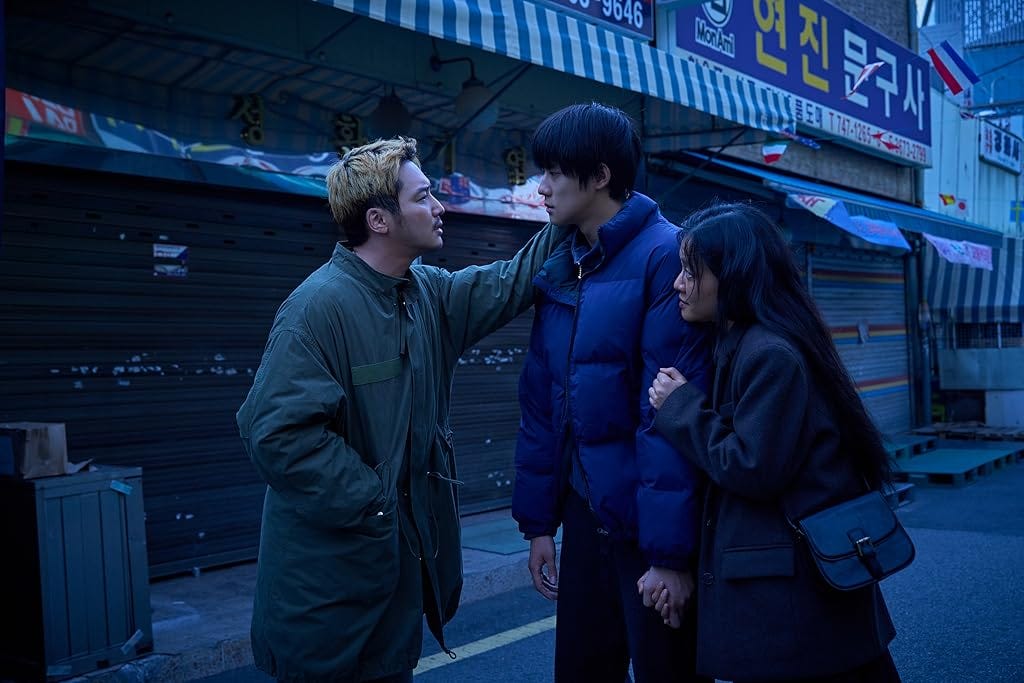
Without detailing every beat: the film ends with Kyung-rok not showing up on December 31st due to him dying. I cannot tell you how many times I dreaded it. The happiness that the film has been carefully building is not sustained in the way you want it to be. People are angry about this. Why do Korean films keep doing this? is a question I have seen asked many times asked these past few weeks and I don’t think it’s an unfair question. But I keep coming back to the film’s title. A pavane for a dead princess is a piece of music written in mourning. Lee Jong-pil has been making a film about mourning from the very beginning — mourning the years Mi-jung has lost, mourning the person she might have been without the world’s cruelty, mourning the love that Kyung-rok almost doesn’t let himself have. The ending is not a betrayal of what comes before. It is the completion of it.
What stays with you though, what the film is ultimately about is not whether love persists but what it does to you while it lasts. Mi-jung is changed by being chosen. Permanently, irreversibly changed. And perhaps that is enough. Perhaps that is even everything.
I cried so much afterward and thought that perhaps the best thing a film can do is refuse to comfort you cheaply. From Novel to screen. I haven’t read Park Min-gyu’s source novel, and so I can’t speak to the fidelity of the adaptation in granular terms. What I can say is that the film feels profoundly literary in its sensibility, in its patience, its interiority, its willingness to trust implication over explication.
Final Thoughts
Pavane is not an easy film to recommend in the conventional sense because a couple of people may complain about its slow pacing but to me I think that’s genuinely what completes it for me. Not every film is meant to be fast paced or even normal paced if you get what I mean, and certainly not this because it requires the audience to grow and trust the characters which inherently isn’t a good thing to do if you do not want to get your heart broken. It is rather how brief love can permanently reshape how people see themselves. These are characters who believe they do not deserve affection and slowly realise that being chosen once might be enough to sustain them for years. I cannot say it better than that.
Overall score: 9.5
Next time on Barely watched: “Wuthering Heights or WOOD-ering Heights”( working title lol)